The short answer: budget about $2,000 to $5,000 for the package
A hair transplant in Turkey commonly costs $1,500–$5,500 in 2026. That broad market range includes budget offers, standard international-patient packages, premium clinics, and more complex cases. A more practical planning range for a reputable package is about $2,000–$5,000. Premium or unusually advanced cases can reach approximately $6,000–$8,000.
For a standard 3,000-graft procedure, a common price is about $2,500–$3,500. Higher-end DHI packages may reach roughly $4,500 or more. The clinic quote is not determined by graft count alone: technique, surgeon involvement, clinic tier, donor-area complexity, accommodation, and the scope of aftercare all affect the price.
Most Turkish international-patient quotes use a fixed package price with a defined graft limit rather than a strict per-graft bill. That makes budgeting easier than an open-ended quote, but the graft estimate still needs to be medically appropriate. In the United States, hair restoration is more often presented using a per-graft model, so the pricing can look different even when the underlying procedure is similar.
Your complete cost will be higher than the package if you are traveling from the United States. Round-trip airfare commonly adds $500–$800, before meals, travel insurance, extra hotel nights, and personal spending. Flights are usually excluded, and standard health insurance generally does not cover elective hair transplantation.
What a 2026 price looks like at each graft level

A graft is a naturally occurring follicular unit, not an individual hair. One graft can contain one or more hairs, so two procedures with the same graft count can produce different hair counts and visual coverage.
| Planned grafts | Common treatment goal | Typical price range |
|---|---|---|
| 2,000 | Receding hairline, temples, or limited crown thinning | $1,800–$3,500 |
| 3,000 | Frontal third and mid-scalp | $2,000–$4,500; a typical FUE quote is about $2,500–$3,200 |
| 4,000 | Front, mid-scalp, and part of the crown | $2,400–$5,500 |
| 5,000 | Extensive coverage, sometimes requiring staged treatment | $2,500–$6,500 |
For technique-based planning, standard FUE commonly falls around $1,800–$4,500, Sapphire FUE around $2,000–$5,000, and DHI around $2,500–$6,000. DHI is typically more labor-intensive, which helps explain its higher quotes, but a higher price does not make it universally superior.
Most patients receive approximately 2,500–3,500 grafts, although the appropriate number depends on donor density, hair caliber, hair-loss pattern, and likely future loss. A larger number is not automatically a better plan. Harvesting beyond what the donor area can safely provide may thin the back and sides and limit future options.
As a rough time guide, 2,000 grafts commonly takes about 5–6 hours, 3,000 grafts about 6–7 hours, and 4,000 grafts about 7 hours or longer. Very large sessions may require two consecutive days. A clinic should not promise a large number of grafts before assessing your donor area.
What the all-inclusive package usually pays for

An all-inclusive hair-transplant package commonly bundles the procedure under local anesthesia, a preoperative assessment, routine blood tests, graft assessment, hairline planning, postoperative medication, an aftercare kit, and a first wash or early check. Hotel accommodation and airport-to-hotel and hotel-to-clinic transfers are also often included.
Many international-patient packages provide two to four hotel nights, commonly in a four- or five-star hotel, plus an English-speaking coordinator, interpreter, or personal host. Remote follow-up may continue for 12–18 months, although the clinic should define what that includes. PRP is included in some packages and sold separately in others; its inclusion does not make it a necessary treatment.
A fixed package price can make budgeting easier because you know the expected medical and local-trip costs before traveling. It does not mean the clinic should offer an unlimited number of grafts. The proposed graft count must match your donor density, hair-loss pattern, hair characteristics, and long-term plan. Harvesting too many grafts simply to fit a package or promise greater coverage can damage donor reserves and limit future treatment.
“All-inclusive” is not a universal contract. Before paying, obtain the hotel category, number of nights, graft cap, technique, named surgeon, surgeon’s role, medications, follow-up terms, and price for extra grafts or nights in writing. International airfare is usually excluded, as are companion lodging, extra nights, meals beyond included breakfasts, sightseeing, travel insurance, and optional boosters.
Your real U.S. budget: costs outside the clinic quote
For a U.S. patient, start with the medical package and then add the costs of getting to and staying in Turkey. Round-trip airfare commonly costs about $500–$800, although West Coast departures, high-demand seasons, and late bookings can cost more than East Coast departures.
A three- to four-day stay may add roughly $40–$200 for food, depending on where and how you eat. Sightseeing and personal spending commonly add $50–$250. Travel insurance can cost about $150–$300, and an extra hotel night may add $60–$150.
For example, a 3,000-graft package priced at roughly $2,500–$4,500, combined with airfare and ordinary travel expenses, commonly produces a complete trip budget of approximately $3,200–$5,800. PRP, laser therapy, mesotherapy, growth kits, and regenerative treatments can increase the bill when they are not included.
Elective hair restoration is generally paid out of pocket. Reconstructive treatment after trauma or burns may be handled differently by an insurer, but you should not assume coverage. Card, cash, and bank-transfer policies vary, so document the payment schedule, deposit rules, cancellation terms, and refund conditions before traveling.
Why one clinic quotes $1,500 and another quotes $6,000
The price gap is best understood as a value-and-risk question, not as proof that the most expensive clinic will produce the best result. Quotes vary with surgeon expertise, the surgeon’s direct role, clinic reputation, technique, graft number, donor-area complexity, city, accommodation, facility standards, and follow-up.
Turkey can offer lower prices because of lower labor and operating costs, high procedure volume, medical-tourism infrastructure, and strong competition. Istanbul is the main international hub and generally offers more international-patient infrastructure and clinic choice than other Turkish cities. Those legitimate efficiencies are different from cutting corners.
A very low quote may reflect limited doctor involvement, a high daily patient volume, reduced aftercare, unclear facility standards, or a package that does not cover what you assumed. A fixed price also does not mean unlimited harvesting is medically appropriate.
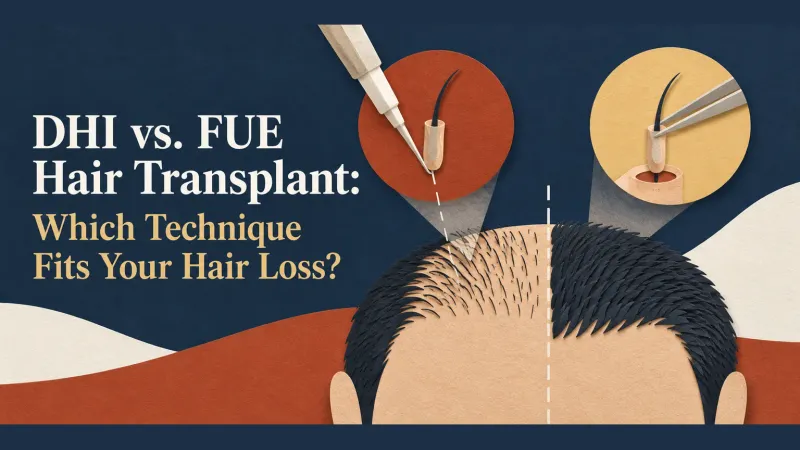
FUE removes individual follicular units. DHI uses a Choi-type implanter pen and is typically more labor-intensive. Sapphire FUE uses sapphire-tipped blades to create recipient channels, but the instrument itself does not guarantee a better result than skilled standard FUE. FUT removes a strip of scalp and leaves a linear donor scar, while FUE and DHI remove individual units rather than a strip.
PRP, stem-cell, and exosome claims should not be treated as proof that an add-on is necessary or will guarantee additional growth. Likewise, robotic or “unlimited graft” marketing should not replace an assessment of your donor supply and long-term hair-loss plan.
The safety checks that belong in your price comparison
Before comparing prices, verify that the provider is licensed and that the responsible medical team is clearly identified. The Turkish Ministry of Health regulates licensed healthcare providers and maintains licensing information that patients should verify before booking.
Ask which doctor is responsible for diagnosis, hairline design, extraction, channel creation, implantation, and medical supervision. The clinic should explain who performs each step rather than referring vaguely to an “expert team.” A qualified doctor should assess whether your available donor tissue can support the proposed graft count. An exact, unusually large number promised without a meaningful assessment is a warning sign.
Protecting the extraction zone is part of the value calculation. Overharvesting can thin the back and sides and reduce the supply available for future treatment. Request genuine before-and-after cases with comparable hair loss, hair type, graft count, lighting, and follow-up time.
Your written quote should identify the facility, procedure, graft cap, technique, named surgeon, hotel, transfers, medications, follow-up, cancellation terms, and revision policy. Promises of unlimited grafts, guaranteed density, guaranteed lifetime results, immediate deposit pressure, or an unnamed surgeon are red flags.
Ask what happens if you develop an infection, poor growth, or another problem after returning to the United States. Early shedding can occur; visible growth commonly begins around the third or fourth month, and final results are generally assessed around 12 months. The safety and outcome depend more on responsible medical supervision, patient selection, technique, donor preservation, and aftercare than on the country name or hotel category. A cheap procedure can become the most expensive option if repair is later required.