The short answer: DHI is a placement variation, not a better version of FUE
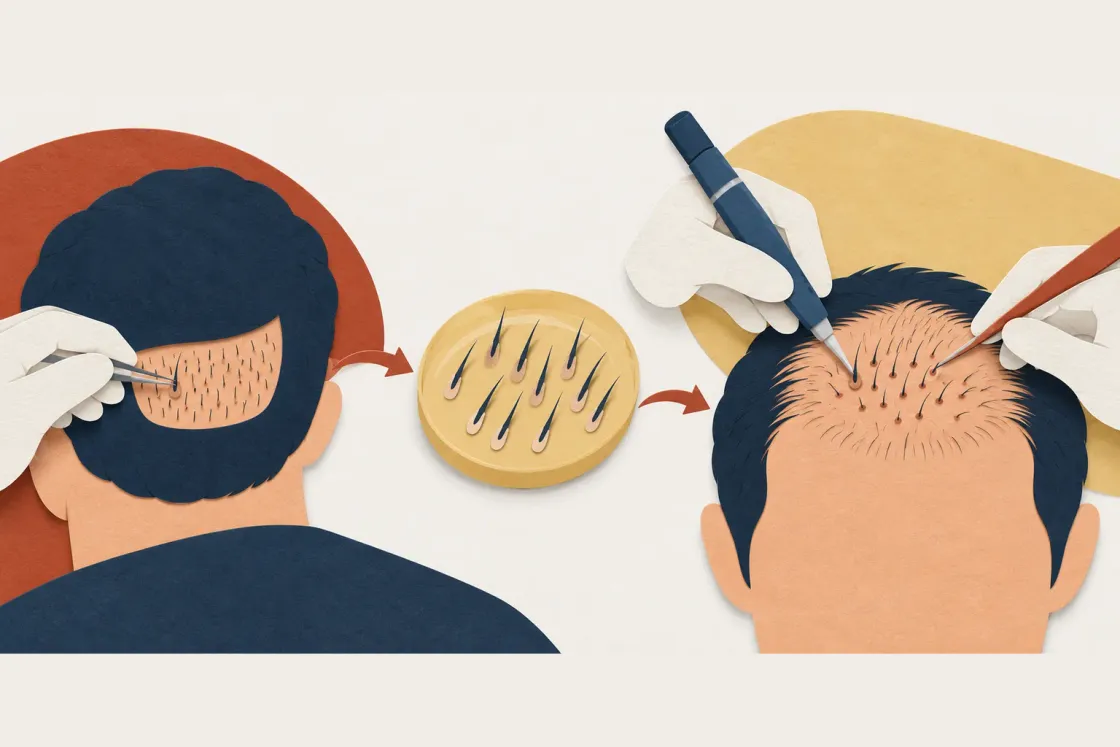
DHI and FUE are often presented as competing hair-transplant techniques, but that description is incomplete. In most cases, both begin by removing individual follicular units from the donor area—usually the back or sides of the scalp—with a small punch under local anesthesia. The important difference comes during implantation.
With conventional FUE implantation, the clinical team creates recipient sites or channels first. The harvested grafts are then placed into those openings, commonly with forceps. DHI uses a hollow Choi implanter pen. A graft is loaded into the pen, and the pen creates the recipient opening and places the graft in the same action. DHI therefore changes the implantation workflow; it does not make follicle extraction fundamentally different from FUE.
Our practical recommendation is straightforward: FUE is usually the better default when a larger area needs substantial coverage or the graft requirement is high.
The decisive variables are the diagnosis, donor planning, hairline design, graft handling, and the skill of the surgeon and medically supervised team. A well-planned FUE procedure can look more natural than a poorly planned DHI procedure. A consultation should also establish who evaluates your thinning, who extracts the grafts, who creates recipient sites, and who implants them.
How FUE and DHI work, step by step
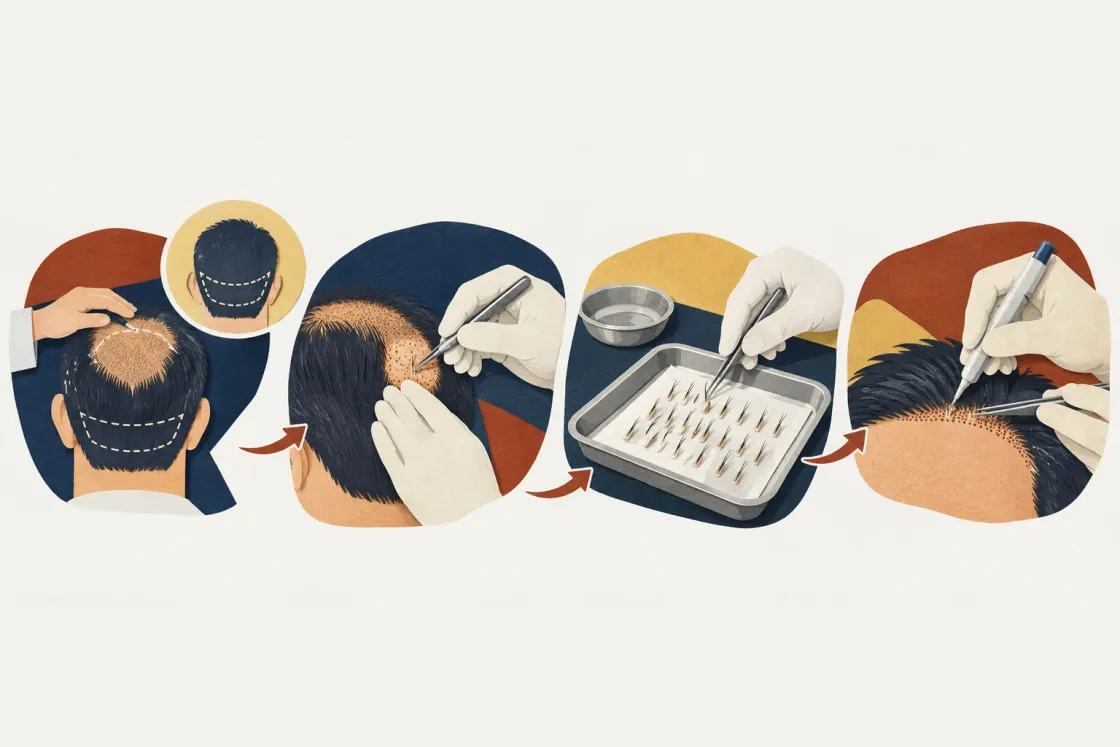
A hair transplant starts with an assessment of the cause and pattern of thinning, donor density, scalp condition, hair characteristics, and realistic graft requirements. The clinician should also consider how untreated hair may change over time. Both FUE and DHI normally use local anesthesia.
In the extraction stage, individual follicular units are removed from the donor area with a punch. A follicular unit naturally contains one to four hairs. The punch must be selected and angled carefully, especially when the follicle curves beneath the skin. Poor extraction technique can injure grafts or overharvest the harvesting zone regardless of whether the later implantation uses forceps or a pen.
The extracted grafts are sorted and kept hydrated in a sterile setting while they are outside the body. In an FUE-based procedure using conventional implantation, the team then creates recipient sites with blades or needles. These sites determine the direction, angle, depth, spacing, and distribution of the grafts. Grafts are inserted afterward, commonly with forceps.
DHI follows the same general extraction and graft-preparation stages. During implantation, a graft is loaded into a hollow implanter pen, commonly a Choi implanter pen. The pen enters the scalp, creates the opening, and deposits the graft. This does not mean DHI eliminates incisions; it means the opening is made at the moment of insertion rather than in a separate channel-creation step.
DHI often takes longer per graft because each graft must be loaded and placed individually. The exact instruments, graft limits, division of work among assistants, and level of physician involvement vary by surgeon and clinic. Those details should be explained before treatment rather than inferred from the technique name.
The differences that actually affect your decision
Treatment area and graft volume are usually the most practical dividing lines. FUE is commonly selected when the plan involves broad coverage, a crown, the mid-scalp, diffuse thinning, or a relatively high graft count. Creating recipient sites separately makes large sessions more efficient. DHI can be useful when the treatment zone is localized and individual placement control is especially important.
Time and cost also differ. DHI generally takes longer for the same number of grafts because grafts must be loaded into an implanter pen and placed one at a time. It is also generally priced higher because of specialized equipment, additional handling, and longer procedure time. Neither approach guarantees a particular graft count: the safe number depends on donor supply and long-term planning.
Shaving requires careful interpretation. DHI may permit partial-shave or no-shave implantation in selected cases, but this is not guaranteed and does not necessarily mean the donor area can remain unshaved. The feasibility depends on hair length, treatment size, graft characteristics, and surgeon experience. A no-shave request should be discussed specifically rather than accepted as a package promise.
Control and naturalness are not exclusive to DHI. Both methods can be used for hairline work. Naturalness depends on conservative design, the selection of single-hair grafts at the front, and correct angle, direction, spacing, and depth. A higher advertised density does not prove higher long-term growth or a better cosmetic result.
Some patients benefit from a hybrid plan: FUE-style implantation for broad coverage and implanter-pen placement in a smaller, delicate hairline zone. The right choice is the workflow that fits the pattern of loss, donor supply, budget, and the clinician’s demonstrated skill—not the technique with the most premium-sounding name.
Results, recovery, and risks: what you should realistically expect
FUE and DHI are minimally invasive procedures performed with local anesthesia, but neither is risk-free or literally scar-free. Individual donor extraction leaves small dot-like marks. Both procedures can also cause temporary redness, small scabs, tightness, swelling, sensitivity, or discomfort in the donor and recipient areas. The visible healing period is commonly about 7 to 10 days, although recovery varies.
A small DHI procedure may produce less visible recipient-site trauma in some cases, but DHI does not guarantee faster overall recovery. The size of the treated area, the number of grafts, skin response, aftercare, and the technique used all influence healing. Shock loss can occur with either method and may temporarily affect transplanted or nearby native hairs.
Growth is gradual. Early shedding can occur after surgery, followed by new growth over several months. Noticeable improvement commonly develops during the middle months, while the cosmetic result is usually judged around 9 to 12 months. Transplanted follicles are intended to provide long-term growth, but untreated native hair can continue to thin. A transplant redistributes donor hair; it does not cure the underlying tendency toward hair loss.
Potential complications include infection, bleeding, prolonged inflammation, poor growth, graft injury, unnatural angling, overharvesting, an unsatisfactory hairline, and ongoing recession around the transplanted area. Washing, exercise, sun exposure, and medication instructions must come from the treating clinician who knows the procedure and your medical history.
How to choose between DHI and FUE for your pattern of hair loss
Start with a diagnosis, not a technique label. Active or unexplained thinning should be evaluated before surgery, and medical treatment may be appropriate to stabilize native hair or show that transplantation is premature. The clinician should assess donor density, scalp health, hair caliber, and the likely progression of loss.
A small hairline or temple refinement may suit DHI or carefully executed FUE. The deciding factor is precise design and graft selection, not simply the use of an implanter pen. Crown, mid-scalp, or full-scalp restoration usually favors FUE because these areas often need efficient, scalable implantation. With advanced baldness, the limiting issue is usually donor supply: one procedure may not recreate the density of the original scalp, so a conservative hairline and realistic coverage plan matter more than choosing DHI.
Diffuse thinning needs particular caution. If native hair is unstable, placing grafts among it may not solve the underlying problem and can complicate future planning. A limited donor area likewise makes conservative design more important than a premium implantation label. The safe donor supply is finite, and overharvesting can create visible thinning.
Hair characteristics also affect planning. Curly or tightly curled hair may require specialized extraction because the follicle can curve beneath the skin. Fine hair may need careful hairline design and density planning, but it is not automatically a reason to choose DHI.
If avoiding a fully shaved head is important, discuss it before booking. DHI may allow partial-shave or no-shave implantation in selected cases, but donor harvesting may still require shaving, and the option depends on hair length, treatment size, graft characteristics, and surgeon experience. A no-shave request can also make a large procedure less practical.
Ask for a long-term plan covering future native-hair loss, possible medical treatment, donor limits, and realistic coverage for advanced loss. The best method is the one that achieves a natural design without spending donor grafts too aggressively.
What to verify before you book a hair transplant
For a U.S. patient, clinic evaluation should focus on medical responsibility and continuity of care as much as on the advertised technique. A treating physician should evaluate the cause and pattern of hair loss before recommending surgery. The consultation should cover donor-area assessment, recipient-area design, expected graft requirements, and a long-term strategy.
Ask exactly which licensed clinician performs each step: extraction, recipient-site creation, and implantation. If technicians assist, the clinic should explain which tasks they perform and under whose medical supervision. You should also receive clear information about graft counting, sterile technique, anesthesia, emergency arrangements, and follow-up.
Review before-and-after photographs showing comparable hair-loss patterns, hair characteristics, lighting, angles, and follow-up intervals. A DHI label, Choi implanter pen, sapphire blade, or robotic device does not by itself establish better graft survival or naturalness. A low price is not evidence of value if physician involvement, complication management, or follow-up is unclear.
The written quote should state whether pricing is per graft or package-based and what postoperative care includes. The written treatment plan should address future native-hair loss and donor management. If you are considering treatment abroad, account for travel timing, continuity of care, complication management, and the legal and medical credentials of the treating team. The ability to obtain timely follow-up matters if healing or growth does not proceed as expected.